In the absence of refrigeration, two chemistry-based barriers stood between a household and spoilage: salt and fat. Italian rural communities used both — sometimes independently, sometimes in combination — to extend the edible life of meat, pork fat, olives, vegetables, and fish across the months that followed the autumn slaughter and harvest. These methods were not invented in Italy, but their application took regionally specific forms that reflect local ingredients, container materials, and seasonal conditions.
What Brining Actually Does
Salt brine operates through two mechanisms. First, osmosis: salt draws moisture out of cells, reducing the water activity of the food to levels below what most spoilage bacteria can tolerate. The threshold most harmful bacteria cannot survive is a water activity below 0.91 (on a scale of 0 to 1, where 1 is pure water). A saturated brine typically brings food below this threshold within 24 to 72 hours, depending on thickness and fat content. Second, brine creates an ionic environment — high in sodium and chloride — that is chemically hostile to a wide range of pathogens, including Listeria monocytogenes and Clostridium botulinum, provided the salt concentration is sufficient and maintained.
Italian rural brining methods for vegetables — most commonly olives, green tomatoes, fennel, and capers — typically used ratios of 100 to 150 grams of salt per litre of water. Olives required an initial lye soak (using wood ash lye or calcium hydroxide) to neutralise oleuropein, the compound responsible for their extreme bitterness, before brining could proceed. After the lye neutralisation period — which lasted from 8 to 24 hours depending on variety — olives moved into salt brine for two to four months minimum, often with additions of bay leaf, fennel frond, dried chili, or lemon peel.
Lard-Sealing: Fat as an Oxygen Barrier
Rendered pork lard has a melting point of approximately 28–40°C, meaning it remains solid at room temperature in most Italian households throughout the year except in peak summer. This thermal property made it a practical sealing agent. Cooked meats — typically pork ribs, sausage, small birds, and rabbit — were packed into terracotta pots immediately after cooking, then covered with a thick layer of rendered lard. As the lard cooled and solidified over the food, it excluded oxygen from the surface, creating the anaerobic condition necessary to prevent aerobic spoilage organisms from establishing.
The lard-sealed pot was then stored in the coolest part of the house — a cellar, a north-facing stone wall cavity, or a covered pit. Properly prepared, these preserves lasted three to four months without refrigeration. The limiting factor was not bacterial spoilage but oxidative rancidity of the lard itself, which progressed faster at higher temperatures and in the presence of light. Households that stored their lard-sealed pots in true darkness and constant cool could extend viability to six months.
Colonnata and the Marble Conca
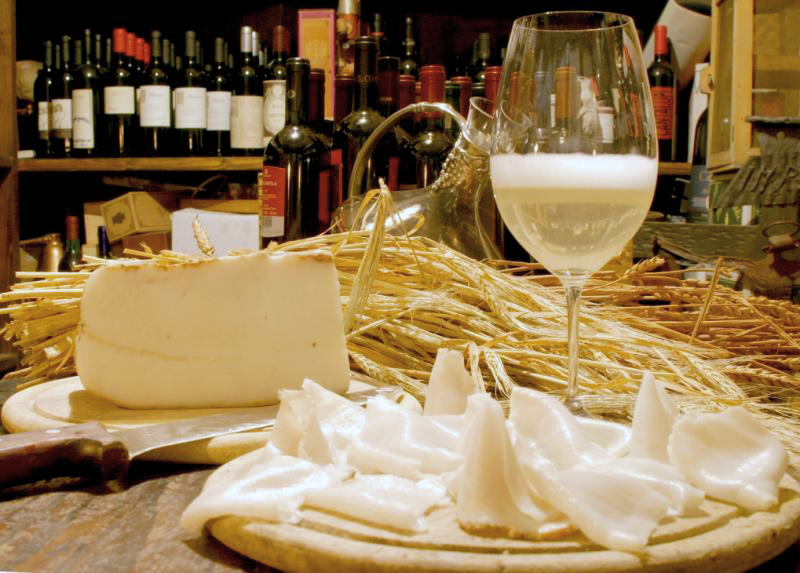
The most documented application of lard-sealing in Italy involves not cooked meat but raw fatback preserved in the form of lardo. Colonnata is a small village in the Apuan Alps above Carrara, Tuscany. Its quarrymen, who worked extracting marble from the surrounding mountains beginning at least in the medieval period, developed a preservation technique that used the same marble they mined as the container material.

The conca — a basin carved from a single block of Carrara marble — was prepared by rubbing its interior surface with garlic. Slabs of fatback from the pig’s back were trimmed to fit, then coated in a dry mixture of coarse salt, rosemary, sage, garlic, black pepper, and sometimes cinnamon or nutmeg depending on the producer’s family recipe. These seasoned slabs were layered into the conca, each layer separated by additional herb mixture. When the basin was full, it was sealed with a marble slab lid and placed in a ground-level storage room.
The marble served a function that no clay or wood container could replicate: it maintained a naturally stable temperature — typically 12 to 14°C in the mountain conditions where Colonnata sits — while also providing micro-porosity that allowed a slow exchange of gases without permitting gross contamination from insects or rodents. The salt drew moisture from the fatback over the first weeks, creating a natural brine that gradually filled the spaces between slabs. After six to twelve months in this brine-saturated, herb-infused environment, the fatback transformed into a product with a completely different structural and flavour profile from its raw starting point.
Brined Vegetables: Scale and Practicality
For households without access to marble or high-quality fatback, the brine method applied across a broader range of produce. Autumn surpluses of green tomatoes, small eggplants, and summer squash were sliced, salted for 24 hours to draw out excess water, then packed into glazed ceramic or glass vessels with a brine solution. A weighted stone or wooden disc was placed on top to keep the vegetables submerged — exposure to air above the brine line accelerated deterioration.
These brine-preserved vegetables were consumed through winter as condiments alongside polenta, bean soups, and bread. They were rarely eaten in large quantities; a tablespoon of preserved capers or half a green tomato alongside a bowl of chickpea soup was a typical winter meal component in parts of Basilicata and Campania. Their role was flavour supplementation rather than caloric contribution.
External references
CooksInfo: Lardo di Colonnata provides detailed documentation of the conca method and its regional history. Istituto Valorizzazione Salumi Italiani covers the classification and production standards of Italian cured lard under current EU regulations.